Risk Assessment
A drill press risk assessment always includes a core set of recognized hazards and requirements. The discussion below describes each hazard, points out the related OSHA requirements, and makes suggestions for remediation.
While the discussion below addresses the most common hazards, a machinery risk assessments should also include an investigation of application-specific hazards.
Recognized Drill Press Hazards
Click on any of the hazards below to learn more about the hazard, how it causes injury, and any related industry standards or requirements.
Coasting & Freewheeling
Industrial machines coast and continue to spin long after they have been turned off. This coasting (or "freewheeling") can last for minutes and puts machine operators at risk as they continue to work around the still-operating machinery. Learn More.
Unintentional Restarting
Automatic and unintentional restarts happen when power is lost while a machine is operating. The machine then starts itself when power is restored. This is a specialized case of hazardous energy control but one that is not solved with typical lockout/tagout procedures. That is why OSHA, ANSI, NFPA, NEC, and CSA all explicitly require means to prevent
the unintentional restarting of machinery. Learn More.
Getting Caught-In or Caught-By Moving Parts (Nip Points)
A nip point hazard is created whenever two adjacent parts of machinery move towards each other and have the potential to capture or draw-in foreign objects like body parts, loose clothing, or hair. These hazards are especially problematic because this type of motion tends to grab and pull an operator towards the hazard, thereby increasing the severity of any incident. This is why OSHA has specific requirements for covers on drive shafts and belts. Learn More.
Contact with Bits
Contact with a drill bit can quickly lead to lacerations, severe entanglement injuries, and amputation. The rotating spindle, chuck, and bit are uniquely dangerous because they can catch loose clothing, gloves, jewelry, or long hair and wind the operator's hand around the spindle in a fraction of a second. Unsecured workpieces compound the hazard – when the bit grabs an unclamped piece, it can spin the workpiece at high speed and drag the operator's hand into the bit before they can react.
Flying Chips, Sparks, and Dust
Flying chips, hot swarf, broken bit fragments, and fine dust regularly exit drill presses at high speed and at unpredictable angles. Long stringy chips from drilling ductile metals like aluminum or mild steel are especially hazardous – they can wrap around the bit, snag on clothing, or strike the operator before settling. This is why OSHA requires eye protection and, where dust levels warrant, respiratory protection during drilling operations.
Drill Press Mitigations and Safeguards
The following safeguards are listed in order of effectiveness, from most effective to least effective, according to OSHA’s hierarchy of controls.
Engineering Controls
- Install an interlocked motor brake system to stop the blade motion quickly after each operation [FED/OSHA 1910.212(a)(1)][1] .
- Install accidental restart prevention. [FED/OSHA 1910.213(b)(3)[2], 1910.212(a)(1)[1] ; CAL/OSHA: §2530.43][3]
- Install an ANSI-compliant emergency stop button. [CAL/OSHA §4001[4]; NFPA 79][5]
- Provide point-of-operation guarding or shielding to reduce exposure to rotating drill bits and flying chips where feasible [OSHA 1910.212(a)(1)][1].
- Fully enclose all pulley mechanisms and rotating components [OSHA 1910.219(d)][6].
- (If dust is generated) Provide interlocked dust collectors or powered exhausts. [FED/OSHA 1910.94(b)(2)[7], CAL/OSHA §5152][8]
Administrative Controls
- Clamp the workpiece securely to the drill press table or use a drill press vise to prevent the workpiece from spinning.
- (if an OEM foot brake is installed) Bring the spindle to a controlled stop before the operator leaves the area or reaches near the rotating bit [OSHA 1910.212(a)(1)][1].
- Use approved lockout/tagout devices and procedures for all maintenance activities. [OSHA 1910.147[9], CAL/OSHA §3314][10]
Personal Protective Equipment (PPE)
- Wear eye protection (safety glasses with side shields or a face shield) [FED/OSHA 1910.133(a)(1)[11], CAL/OSHA §3380][12]
- Avoid gloves, loose clothing, jewelry, and unsecured long hair near rotating spindles, chucks, and drill bits.
- Wear hearing protection where sound levels warrant.
- Wear respiratory protection when drilling materials that generate hazardous airborne dusts.
An All-In-One Solution
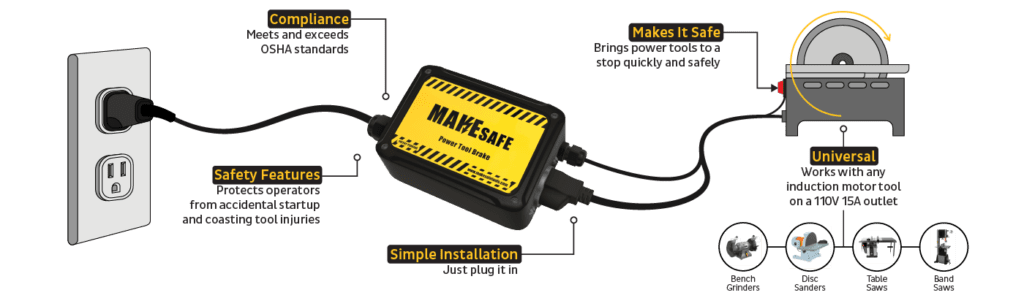
The MAKESafe Power Tool Brake is a plug-and-play braking solution that also includes anti-restart and emergency stop. All you have to do is plug it in, perform a calibration that takes less than five minutes, and you’ve added multiple machine safeguards to your drill press. See the product demonstration video below and/or device specifications for more information.


Scope: The information above is intended for standard bench-top and floor-model drill presses. Additional requirements for radial drill presses, magnetic-base drills, and CNC drilling centers are not included.
FAQs
The most common drill press hazards include contact with the rotating bit, unsecured workpieces being grabbed and spun by the bit, bit breakage, hair or clothing entanglement, coasting after shutdown, unintentional restarting after power loss, and flying chips. Unsecured workpieces are a particularly well-documented hazard — when a drill bit grabs an unclamped piece of stock, the workpiece can spin at high speed and strike the operator with significant force. OSHA addresses drill press hazards primarily through the general machine guarding requirements of 29 CFR 1910.212(a)(1)[1], which require protection against point-of-operation, nip point, rotating part, and flying chip exposure.
Yes. OSHA requires that most motor-driven machinery, including drill presses, have a readily accessible means to quickly disconnect power in an emergency. ANSI and NFPA 79[5] also address emergency stop requirements, and CAL/OSHA §4001[4] specifically requires an emergency stop device for industrial machinery. Fast shutdown is critical on a drill press because if a workpiece comes loose or clothing gets caught, the operator may only have a fraction of a second to stop the bit before a serious injury occurs.
Drilling without clamping the workpiece is one of the leading causes of drill press injuries. As the bit engages the material, especially as it breaks through the back side, it can grab the workpiece and spin it at hundreds of RPM, turning the piece into a high-speed projectile or impact hazard. Operators often try to hold the workpiece by hand, but human grip strength cannot reliably resist the torque a drill bit generates, particularly with larger bits or harder materials. A clamp, vise, or fixture should secure every workpiece to the drill press table before the spindle is powered on. OSHA-funded training materials specifically call out unclamped workpieces as a primary drill press injury mechanism.
Drill bits commonly break or grab when the bit is dull, when the wrong speed is selected for the material, when feed pressure is excessive, when the workpiece is not properly secured, or when the bit binds as it breaks through the back of the material. Prevention includes selecting the correct bit type and RPM for the material, maintaining sharp bits, applying steady moderate feed pressure, clamping the workpiece securely, and easing pressure as the bit nears breakthrough. Inspecting bits before use and replacing dull or damaged bits is also essential as a dull bit generates excess heat and is far more likely to grab.
No. OSHA addresses this directly in both of its relevant publications. OSHA Publication 3170, Safeguarding Equipment and Protecting Employees from Amputations, directs employers to instruct employees not to wear gloves, jewelry, or loose-fitting clothing while operating a drill press, and to secure long hair in a net or cap. OSHA Publication 3157 gives the same direction in its woodworking guidance.
The rotating bit and chuck can catch glove fabric and wind the hand around the spindle in a fraction of a second which is one of the most serious entanglement hazards on any shop tool. Gloves also reduce dexterity and won’t survive contact with the cutting edge, so rather than PPE, the right approach is engineering and work-practice controls: drill shield or chuck guard, securely clamping the workpiece, and proper feed rates. If hand protection is needed elsewhere in the shop, gloves should come off before the spindle is powered on.
Drill presses can continue spinning for 15 to 30 seconds or more after power is removed, depending on the spindle mass, chuck, and bit installed. During that window, the bit is still capable of causing lacerations, entangling hair or loose clothing, or grabbing a workpiece if disturbed. The most effective solution is an electronic motor brake, which stops the spindle in seconds after shutdown and significantly reduces the time the rotating bit remains a hazard.