Risk Assessment
A band saw risk assessment always includes a core set of recognized hazards and requirements. The discussion below describes each hazard, points out the related OSHA requirements, and makes suggestions for remediation.
While the discussion below addresses the most common hazards, a machinery risk assessments should also include an investigation of application-specific hazards.
Recognized Band Saw Hazards
Click on any of the hazards below to learn more about the hazard, how it causes injury, and any related industry standards or requirements.
Coasting & Freewheeling
Industrial machines coast and continue to spin long after they have been turned off. This coasting (or "freewheeling") can last for minutes and puts machine operators at risk as they continue to work around the still-operating machinery. Learn More.
Unintentional Restarting
Automatic and unintentional restarts happen when power is lost while a machine is operating. The machine then starts itself when power is restored. This is a specialized case of hazardous energy control but one that is not solved with typical lockout/tagout procedures. That is why OSHA, ANSI, NFPA, NEC, and CSA all explicitly require means to prevent
the unintentional restarting of machinery. Learn More.
Getting Caught-In or Caught-By Moving Parts (Nip Points)
A nip point hazard is created whenever two adjacent parts of machinery move towards each other and have the potential to capture or draw-in foreign objects like body parts, loose clothing, or hair. These hazards are especially problematic because this type of motion tends to grab and pull an operator towards the hazard, thereby increasing the severity of any incident. This is why OSHA has specific requirements for blade guards and covers for shafts and belts on band saws. Learn More.
Contact with Blade
Contact with a band saw blade can quickly lead to lacerations and amputation. This hazard is especially significant on band saws due to how close an operator's hands come to the blade during some operations.
Flying Chips, Sparks, and Dust
Flying chips, broken teeth, and fine dust regularly exit band saws at high speed during cutting, with debris often directed toward the operator and adjacent work area. Broken blade fragments are an additional concern – a snapped band saw blade can release stored tension and whip outward before coming to rest. Eye injuries and respiratory irritation are the most common outcomes, which is why OSHA requires eye protection and, where airborne dust is generated, appropriate ventilation or respiratory protection.
Band Saw Mitigations and Safeguards
The following safeguards are listed in order of effectiveness, from most effective to least effective, according to OSHA’s hierarchy of controls.
Need an easy to print cheat sheet that contains all of this information? Check out our printable Band Saw Safety Guide.
Engineering Controls
- Install an interlocked motor brake system to stop the blade motion quickly after each operation [FED/OSHA 1910.212(a)(1)][1] .
- Install accidental restart prevention. [FED/OSHA 1910.213(b)(3)[2], 1910.212(a)(1)[1] ; CAL/OSHA: §2530.43][3]
- Install an ANSI-compliant emergency stop button. [CAL/OSHA §4001[4]; NFPA 79][5]
- Fully guard or enclose all portions of the saw blade, except for the working portion of the blade between the bottom of the blade guard guide rolls and the table [OSHA 1910.213(i)(1)][2]. This includes guarding or enclosing any exposed blade under the table.
- Fully enclose all pulley mechanisms and rotating components [OSHA 1910.219(d)][6].
- (If dust is generated) Provide interlocked dust collectors or powered exhausts. [FED/OSHA 1910.94(b)(2)[7], CAL/OSHA §5152][8]
Administrative Controls
- Use fences, jigs, and push sticks during cutting operations to provide separation between the operator and any point of operation or nip point hazards.
- Properly adjust the height of the blade guard before every cutting operation [OSHA 1910.213(i)(1)][2].
- (if an OEM foot brake is installed) Bring the saw blade to a controlled stop before the operator leaves or reaches near the blade [OSHA 1910.212(a)(1)][1] .
- Use approved lockout/tagout devices and procedures for all maintenance activities. [OSHA 1910.147[9], CAL/OSHA §3314][10]
Personal Protective Equipment (PPE)
- Wear eye protection (safety glasses with side shields or a face shield) [FED/OSHA 1910.133(a)(1)[11], CAL/OSHA §3380][12]
- Avoid loose clothing, gloves, jewelry, and unsecured long hair near moving blades and rotating components.
- Wear hearing protection where sound levels warrant.
- Wear respiratory protection when cutting operations generate hazardous airborne dusts.
An All-In-One Solution
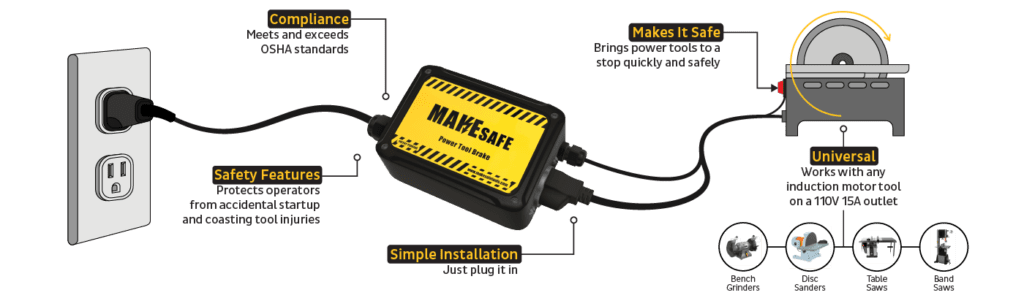
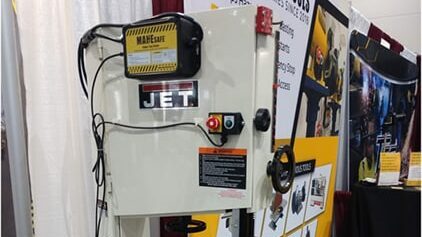
The MAKESafe Power Tool Brake is a plug-and-play braking solution that also includes anti-restart and emergency stop. All you have to do is plug it in, perform a calibration that takes less than five minutes, and you’ve added multiple machine safeguards to your band saw. See the product demonstration video below and/or device specifications for more information.

Scope: The information above is intended for standard vertical and horizontal band saws. Additional requirements for resaw and automatic-feed band saws are not included.
FAQs
The most common band saw hazards include contact with the blade, blade breakage, coasting after shutdown, unintentional restarting after power loss, nip points around the wheels and guides, and flying chips or debris from cutting. Contact injuries are especially significant on band saws because the operator’s hands often come within inches of the moving blade during normal operation. Blade breakage is a unique concern: a broken band saw blade can release stored tension and whip violently before coming to rest. OSHA addresses these hazards through guarding, inspection, and control requirements under 29 CFR 1910.213[2].
Yes. OSHA requires that most motor-driven machinery, including band saws, have a readily accessible means to quickly disconnect power in an emergency. ANSI and NFPA 79[5] also address emergency stop requirements, and CAL/OSHA §4001[4] specifically requires an emergency stop device for industrial machinery. An e-stop is particularly valuable on a band saw because the operator’s hands are routinely close to the blade during feeding, and a fast shutdown can prevent a minor slip from becoming a serious injury.
The upper blade guard should be adjusted to within approximately 1/4 inch of the top of the workpiece before every cut. OSHA 1910.213(i)(1)[2] requires that the blade be enclosed or guarded except for the portion between the bottom of the blade guide rolls and the table – meaning the only blade that should be exposed is the section actively cutting. Keeping the guard low minimizes exposed blade, improves cut accuracy by reducing blade deflection, and significantly reduces the risk of hand contact if a slip occurs.
Band saw blades typically break from improper tension, dull or damaged teeth, feeding too aggressively, using a blade with the wrong tooth pitch for the material, or pinching when the workpiece twists during the cut. Prevention starts with selecting the correct blade for the material and thickness, tensioning it properly per the manufacturer’s specifications, and keeping the blade clean and sharp. OSHA 1910.213(s)(7)[2] requires that cracked blades be removed from service immediately. Inspecting the blade before each use and replacing it at the first sign of fatigue is the most reliable safeguard.
No. OSHA Publication 3157, A Guide for Protecting Workers from Woodworking Hazards, is direct on this: gloves should not be worn when operating woodworking equipment due to the potential for getting caught in moving parts. Heavy leather or mesh gloves may seem like protection against cuts and abrasions, but they reduce dexterity which can increase the frequency of the mishaps they’re meant to prevent, and no glove will survive direct contact with a cutting edge anyway. The right approach is engineering and work-practice controls (blade guards, proper upper guide adjustment, push sticks, sharp blades) rather than PPE.
On a band saw specifically, the blade teeth can catch glove fabric and pull a hand directly into the cutting path before the operator can react. If hand protection is needed for material handling around the shop, gloves should come off before the band saw is switched on.
Band saw blades can continue moving for 30 seconds or more after power is removed because of the rotational mass stored in the upper and lower wheels. During that window, the blade is still capable of causing severe lacerations or amputation if a hand makes contact while reaching for offcuts or changing setups. The most effective solution is an electronic motor brake, which stops the blade in seconds after shutdown and significantly reduces this exposure window.